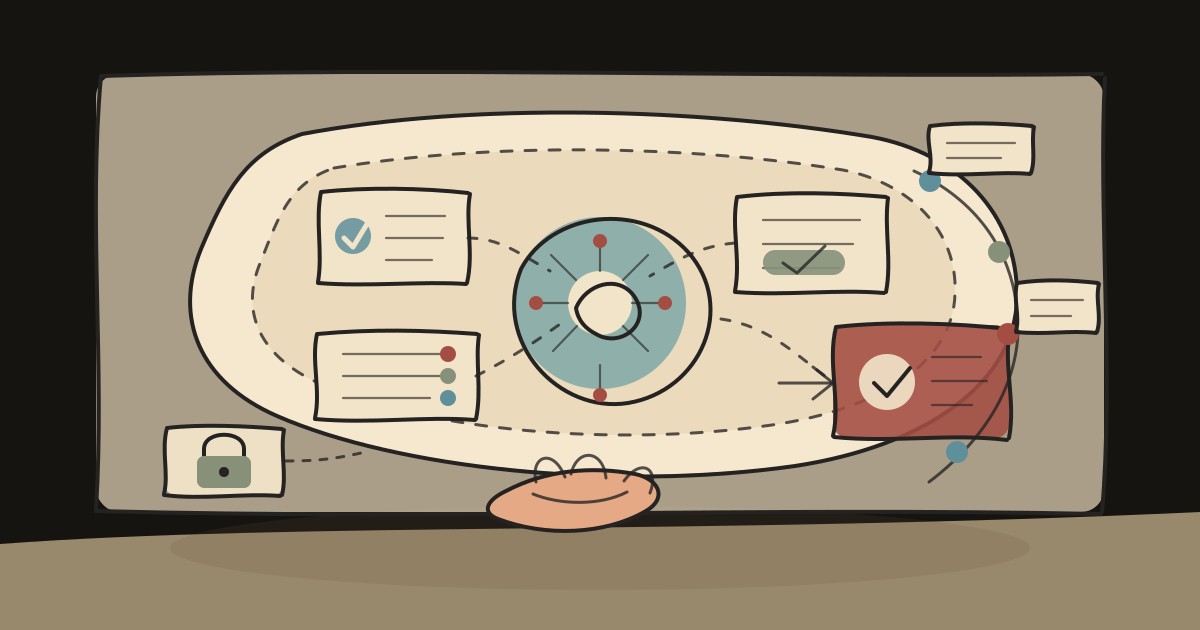

Agentic AI can help SMEs with support, marketing, and operations, but only if access, logs, prompts, and risk controls are designed before rollout.
Agentic AI is not another plugin
Agentic AI is different from the usual chatbot or content assistant. It can plan steps, call tools, read context, and take actions across systems with less prompting from a person.
That makes the business case interesting for SMEs: faster support triage, cleaner marketing drafts, better internal search, and less manual handover between apps.
It also changes the risk profile. On May 1, 2026, CISA and international partners released guidance on secure adoption of agentic AI. Their warning is practical: autonomy expands the attack surface.
For Indonesian teams, the takeaway is not to reject AI. It is to treat an AI agent like a new operational role inside the company, not like a harmless browser extension.
If the agent can access files, send messages, update a CRM, or trigger a workflow, it needs boundaries before it needs more features.
Start where the blast radius is small
The safest pilot is rarely the most dramatic one. CISA recommends starting with low-risk, non-sensitive use cases instead of broad access to critical systems or confidential data.
A practical first use case might be summarizing public product pages, drafting FAQ variants, grouping support tickets, or preparing meeting notes from non-sensitive internal updates.
Avoid connecting a first agent to payroll, finance approvals, customer identity records, inventory changes, or production systems. Those areas can come later, after controls and logs are proven.
Think of the pilot as a sandbox with a clear fence. The team should know what data the agent may read, what actions it may suggest, and what actions it cannot perform.
This is especially important for smaller businesses where access rules often grow informally. A shared admin login or all-in-one spreadsheet can become a serious weakness once an agent is connected.
Access should be earned, not inherited
One of the clearest risks in the guidance is privilege creep. An agent starts with a narrow task, then slowly receives more folders, more tools, and more authority without a formal review.
The better pattern is least privilege. Give the agent the minimum access needed for one job, for one environment, with a named owner who can explain why it exists.
Separate read, write, approval, and deletion rights. An agent that drafts a customer reply does not automatically need permission to send it. An agent that reads stock data does not need to edit it.
Behavioral misalignment also needs attention. A well-worded prompt cannot replace business rules, role design, and monitoring when an agent begins to act across real workflows.
Before expanding access, review what the agent did last month. If the event record is unclear, the access is already too broad for responsible use.
Prompt operations are now part of operations
Recent platform updates show where the market is heading. AWS introduced Bedrock tools to optimize and migrate prompts, compare up to five models, and use evaluation feedback loops.
Amazon Lex Assisted NLU points in the same direction for bots: describe intents and slots more clearly, validate designs in a test workbench, and improve accuracy through structured review.
For business leaders, the lesson is simple. Prompts should not live only in someone’s personal notes. They should be versioned, tested, and tied to the process they support.
A good prompt operation records the task, source data, expected output, approval path, and failure examples. It also tracks which model or bot design was used for each version.
This does not require enterprise complexity on day one. A simple repository, admin panel, or internal knowledge base is already better than copying prompts through chat groups.
Logs are business evidence
CISA also highlights obscure event records as a risk. If no one can reconstruct what an agent saw, decided, or changed, accountability becomes weak.
Useful logs are not just technical server logs. They should answer business questions: who requested the task, what data was used, what output was produced, and which system received the result.
For marketing teams, this matters when AI helps create ad concepts or campaign drafts. Google’s Small Brief shows how AI can support small-business ad ideation, but human review and brand judgment still matter.
For operations teams, logs matter when an agent groups tickets, prepares reports, or suggests follow-up actions. The record protects the company when something needs to be checked later.
If a workflow cannot be logged clearly, keep it advisory. Let the agent draft or summarize, but do not let it execute business-critical changes.
Build the system before the agent
Agentic AI works best when the surrounding system is already disciplined: clean roles, structured data, sensible approvals, backups, and maintenance routines.
That is where a software partner can help. The work is often less about chasing a new model and more about designing the website, app, dashboard, or internal tool that safely hosts the workflow.
Sundie helps teams map where AI belongs, where normal automation is enough, and where human control is still required. The goal is a useful system, not an impressive demo.
A healthy next step is a short risk review for one workflow. Pick a process, classify the data, define access, plan logging, and test the smallest safe version.
When the foundation is clear, AI agents can become careful assistants inside the business. Without that foundation, they become another shortcut with hidden operational debt.
Sources
Source:
Source:
Source:
Source: