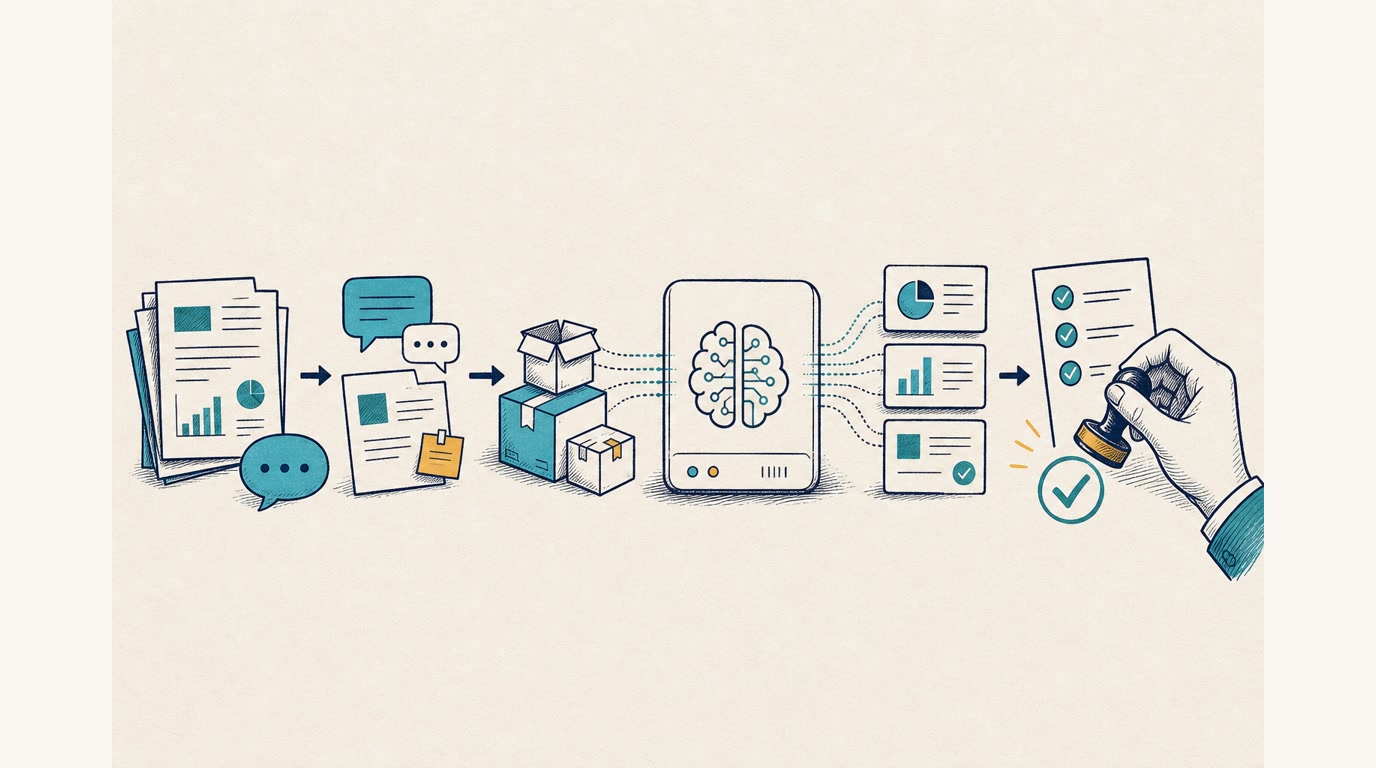

AI is moving from writing help into business data, reports, and decisions. Before teams automate more work, they need firm data rules, human review, and workflows that people can trace.
AI is getting closer to the decisions people care about
For a lot of companies, AI entered the office through harmless work such as captions, email drafts, meeting notes, and summaries of documents nobody had time to read properly. That was useful, but it also made AI feel like a writing shortcut instead of an operating layer. The newer signal is different. On May 15, 2026, OpenAI introduced a personal finance preview in ChatGPT for Pro users in the US, where financial accounts can connect securely so the answers reflect a person's context, goals, and priorities. OpenAI also published examples of business operations teams using Codex for initiative briefs, strategy updates, leadership decision packets, and progress reports built from real work inputs. For business owners, the point is not that every workflow suddenly needs a chatbot. The point is that AI is moving nearer to data, judgment, and routine decisions. Once that happens, the first question is boring but necessary. Which data can it see, who checks the answer, and where does the result go next?
Trust has to be designed before the tool is connected
The moment AI touches financial context, customer records, internal reports, or operational documents, the benefits become more interesting and the risk becomes less theoretical. A summary can be sharper because it sees the right inputs. A recommendation can be more relevant because it knows the actual condition of the business. But the same closeness can turn into a problem if a company has not classified its data. Before any external service is connected, teams should agree on plain labels such as public, internal, confidential, and restricted. They should also keep an audit trail that shows who uploaded a document, why it was used, where the AI output went, and who approved the next step. This is not paperwork for its own sake. It is the difference between automation that can be explained and automation that only looks clean on the surface. Trust also includes brand assets. The Verge reported YouTube's expansion of AI likeness detection to all adult users so people can find deepfakes using their face or likeness and request removal. Companies need the same seriousness around founder images, testimonials, campaign material, and response plans when misuse appears.
Polished AI content still needs a named reviewer
AI output often looks finished before it has earned that confidence. That is what makes it dangerous in public content and internal reporting. The sentence is smooth, the structure is neat, and the mistake can hide inside the polish. Google has updated spam rules aimed at reducing attempts to manipulate AI responses in Search, including AI Overview and AI Mode, according to coverage of its AI Search spam policy. Academic publishing is feeling similar pressure. arXiv has reportedly been preparing one-year bans for researchers who upload papers with strong evidence of unchecked LLM content. Those examples sit in different worlds, but the business lesson is close enough. A proposal, blog post, SOP, product description, training module, or management report needs a process owner, not just a prompt. Review should cover factual claims, names, numbers, references, tone, positioning, and whether the advice matches what the company can actually deliver. The uncomfortable part is that review takes time. The practical part is that it prevents public embarrassment, customer confusion, and internal decisions built on text that sounded more certain than it was.
Workflow quality decides whether AI helps or just speeds up noise
Most failed automation projects do not fail because the model was not impressive enough. They fail because the workflow underneath it was already messy. File formats change from team to team, access rights live in someone's memory, approvals happen in chat, and nobody can say which spreadsheet is the official one. Add AI to that environment and it will not clean the process by itself. It may summarize the wrong file faster, repeat an outdated number with confidence, or turn scattered notes into a polished report that still carries the same confusion. AI becomes useful when the operating flow is visible. The team knows where the data comes from, who owns it, how often it changes, which system stores it, which actions may be automated, and which moments still require a human decision. A weekly sales report is a simple example. If POS, inventory, and stock records are clean, AI can summarize trends, flag anomalies, and prepare discussion notes for management. If the records are inconsistent, the model only makes the inconsistency easier to circulate.
Start small, but make the pilot strict
A useful AI pilot should feel almost narrow at first. Pick one process with clear value and limited blast radius, such as sales recaps, lead follow up, attendance reports, customer ticket summaries, or marketing drafts. Then define the business goal in ordinary language. Faster follow up is a goal. Fewer manual recaps is a goal. Better preparation for weekly management decisions is a goal. Producing more text is not much of a goal by itself. After that, map the data source, owner, update rhythm, and usage limits. If the team cannot explain where the data came from, AI should not be asked to make it sound authoritative. Set human validation points for finance, legal, health, reputation, and public communication. Use a consistent output format so the result can enter dashboards, documents, or existing work systems without another round of copy paste confusion. Measure process quality rather than word volume, including processing time, revision count, report consistency, follow up quality, or reduced repetitive manual work. Once the pilot works, expand with the same discipline instead of improvising a bigger mess.
The clean system comes before the smarter assistant
If your business is considering AI for operations, the healthiest first step is not buying another tool. It is sitting down with the process and being honest about what is ready. Which data is reliable? Which systems need cleanup? Which approvals are invisible? Which risks would hurt customers, employees, partners, or the brand if an AI answer moved too quickly? That conversation can feel slower than a demo, but it saves expensive confusion later. The foundation is not glamorous. Databases, dashboards, document structure, user roles, backups, and approval procedures decide more than the demo usually admits. Still, this is where the value of AI is usually decided. A stronger foundation lets AI support decisions, reduce repetitive work, and protect trust rather than turning half-finished operations into faster half-finished operations. Sundie can help map digital product needs, dashboards, internal apps, and simple automation in stages. The aim is not to use AI for its own sake. The aim is to build workflows that are clear enough for people to trust and clean enough for automation to handle without creating a new problem.