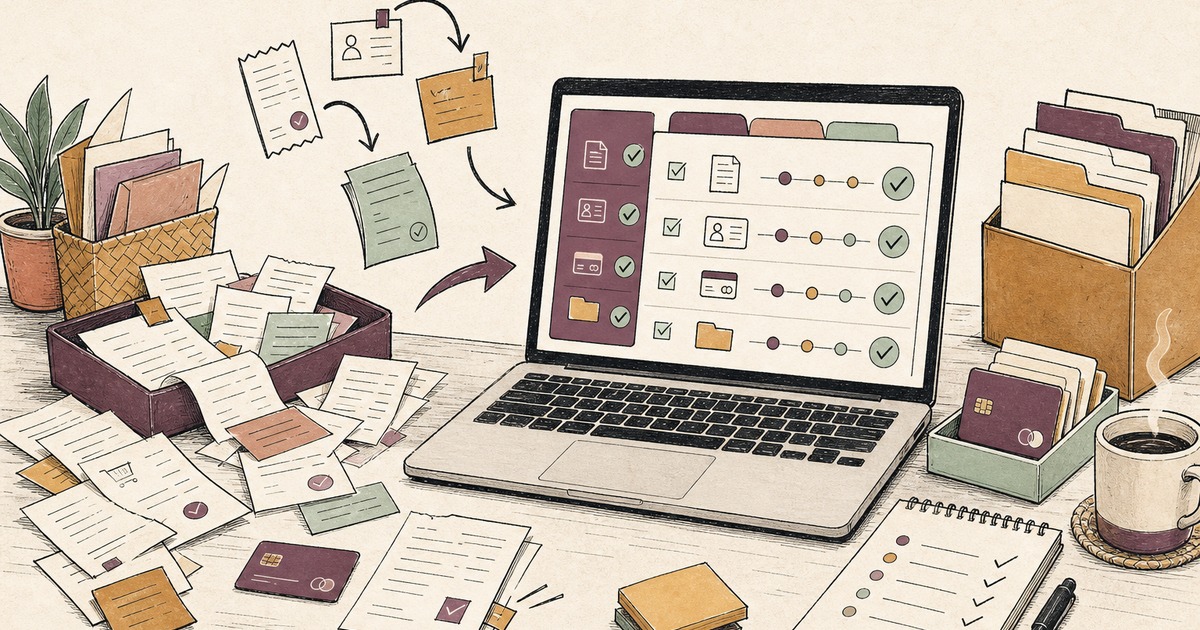

For Indonesian SMEs, Coretax and digital payments make messy invoice, customer, order, and payment records harder to ignore.
Coretax makes data discipline harder to postpone
Coretax is often discussed as a tax system update. For a small business, the practical signal is wider than tax. Clean records now matter earlier in the daily flow.
Invoice numbers, customer names, order references, and payment proof may look like admin details. When they are inconsistent, every report becomes harder to trust.
This does not mean every SME needs a large finance system. It means the basic data behind invoices and payments should stop living only in chat threads and scattered spreadsheets.
Where messy invoice and payment records leak time
The leak usually starts with small differences. One customer is written with three names. One invoice is paid in two transfers. One order has a WhatsApp note but no matching invoice.
Digital payment habits make the gap more visible. QRIS and bank transfers can speed up collection, but the business still needs to connect each payment to the right order and customer.
Finance staff spend time asking which payment belongs to which invoice.
Sales teams cannot quickly see whether an order is paid, unpaid, revised, or cancelled.
Owners receive totals that need manual checking before they can be used.
The result is not only slower reporting. It also creates hesitation before adopting stronger automation, because the input data is already uncertain.
Data fields worth standardizing first
Before adding a complex tool, agree on the fields that must be captured every time. The goal is not bureaucracy. The goal is fewer exceptions during closing, follow up, and export.
A useful starting set is simple enough for daily staff to follow and structured enough for finance to review later.
Customer master data with one official name, phone number, tax identity when needed, and billing address.
Order and invoice numbers that follow one pattern and cannot be reused by accident.
Payment status, payment channel, payment date, proof reference, and remaining balance.
User roles so sales, warehouse, finance, and owners do not edit the same fields without control.
Once these fields are stable, reports become less about hunting for missing context and more about checking business movement.
How a simple system helps without becoming a huge ERP
A practical system can start with forms, validations, and a shared dashboard. It does not have to replace every spreadsheet on day one.
For example, staff can create an order through a standard form, generate or record an invoice, upload payment proof, then mark the payment status in one place.
The owner can see unpaid invoices, recently paid orders, payment channels, and exceptions that need review. Finance can export clean reports for tax or accounting work.
Access control matters here. A system should make everyday work easier while reducing accidental edits, duplicate records, and unclear responsibility.
A small first step for Indonesian SMEs
Start by reviewing the last thirty to sixty days of invoices and payments. Look for repeated customer names, missing invoice numbers, unclear payment proof, and orders that are hard to match.
Then choose one standard flow for new transactions. Keep it modest. A good first version can cover customer data, order entry, invoice status, payment matching, and exportable reports.
If the business already uses QRIS, bank transfer, marketplace orders, or manual invoices together, reconciliation is a sensible first dashboard. It gives the team a practical reason to keep data clean.
Closing note and sources
Sundie helps Indonesian businesses turn scattered operational work into websites, e-catalogs, dashboards, inventory tools, POS flows, finance workflows, and custom apps that fit the way the team actually works.
If invoice and payment records are starting to slow your team down, Sundie can help map a simple first system before you commit to heavier automation.
This draft refers to the official DJP Coretax page, Bank Indonesia information on QRIS, and Bank Indonesia information on SNAP payment open API standards.