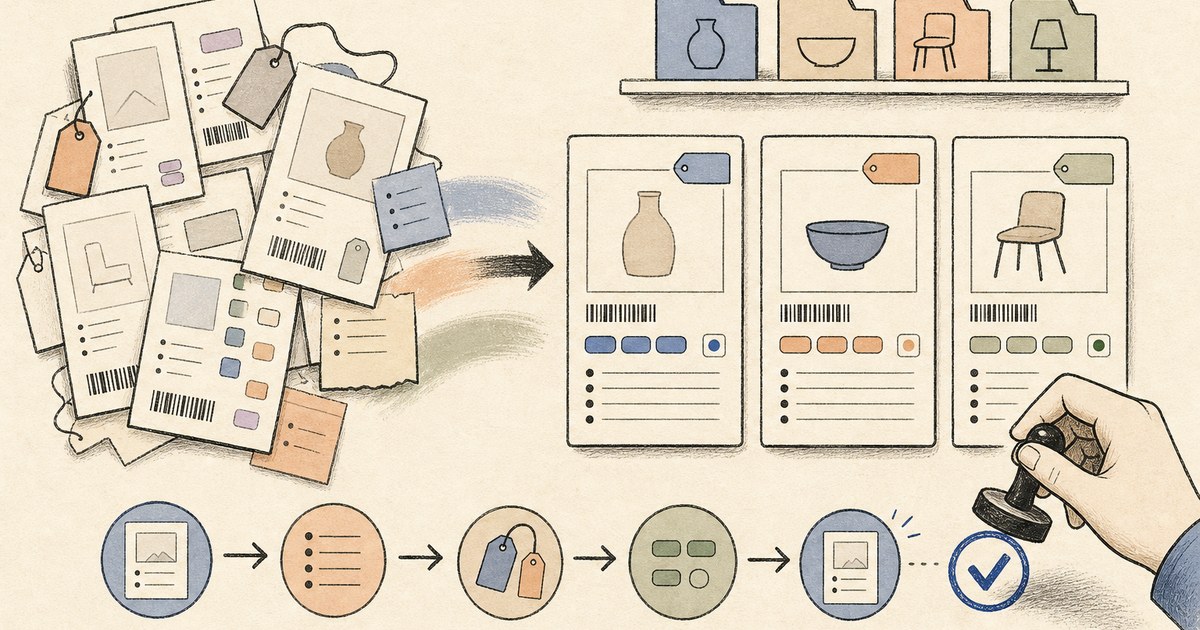

Before redesigning an SME e-catalog, teams should clean product data such as SKU, barcode, photos, price, availability, and specifications.
Design cannot fix messy product records
Many SME e-catalog projects begin with layout requests. The team wants cleaner cards, faster search, and a more premium look for customers or sales staff.
Those improvements matter, but the catalog will still feel unreliable when product data is thin. Duplicate names, missing photos, unclear units, and old prices create doubt before anyone talks about design.
Start with product identity before the screen
Each product needs a stable internal SKU that the business can keep using across purchasing, sales, finance, and service teams. The SKU should describe the item clearly enough for staff, without changing every time a campaign changes.
For packaged goods, barcode or GTIN data helps reduce guessing between similar variants. GS1 Indonesia is a useful local reference for product identification standards, especially when a business handles resold or distributed products.
Write product information for real buyers
A product title should be short, specific, and consistent. Google Merchant Center guidance treats title, description, image, availability, price, brand, GTIN, and MPN as important product attributes, which is also a helpful checklist for internal catalog hygiene.
Descriptions should answer buying questions in plain language. Size, material, compatibility, packaging quantity, warranty scope, and usage notes often matter more than decorative wording.
Photos and specifications need one operating rule
Customers and sales teams trust a catalog faster when every product uses a similar photo style. A simple rule for front view, detail view, packaging view, and file naming can prevent weeks of cleanup later.
Specifications also need controlled fields. If one team writes capacity as 500 ml, another writes 0.5 liter, and another leaves it in the description, filtering becomes weak and comparison becomes harder.
Prices and availability should show the right level of promise
Price data should match how the business actually sells. Some SMEs need retail price, reseller price, project price, or price on request. The catalog should make that policy clear instead of forcing one public number for every case.
Availability can mention stock as one product data signal, but it should not turn the e-catalog into a warehouse article. For many teams, a simple status such as available, limited, made to order, or discontinued is enough for the first version.
Structured data helps systems understand the catalog
Google Search Central explains that product structured data helps search systems read product details such as price and availability. Schema.org also defines product properties including brand, category, description, image, offers, SKU, and GTIN.
That does not guarantee ranking gains, and it should not be sold that way. The practical benefit is cleaner product meaning across the website, admin panel, feed exports, and future integrations.
A practical cleanup path for SMEs
Before redesigning the e-catalog, Sundie usually recommends a small data audit. Pick several high value categories, inspect their SKUs, names, photos, prices, availability status, and specifications, then agree on a repeatable rule.
After that, the system can support better forms, validation, import templates, and review steps. This is where a software partner creates long term value beyond a prettier gallery.
Sources used for this draft
This draft used Google Merchant Center Help for product attribute guidance, Google Search Central for product structured data context, Schema.org for Product vocabulary, and GS1 Indonesia for local product identification reference.
The article avoids claims about guaranteed search ranking results and does not discuss public procurement e-catalogs. It focuses on SME product data readiness before a sales or customer catalog goes live.