Can your infrastructure handle traffic spikes without crashing? Learn how Kubernetes automates scalability, ensures uptime, and turns cloud costs into efficient investments.
Picture this scenario: Your business launches a massive marketing campaign. Ads are running, traffic is flooding in, and sales charts are climbing vertically. Suddenly, at the peak of customer enthusiasm, your website or application slows to a crawl, then dies completely. "Error 503: Service Unavailable." In an instant, your ad spend is incinerated, and all that remains is customer frustration vented on social media.
In the digital economy, downtime is not merely a technical glitch; it is financial hemorrhaging and reputation damage. Traditional, static infrastructure—where you rent servers with fixed capacity—is no longer sufficient to handle the volatile dynamics of the modern market. You need a system that is "alive," one that breathes, expanding and contracting in real-time response to demand.
This is why tech giants from Google to Spotify, and modern financial institutions, have migrated to Kubernetes. At Sundie Enterprise, we view Kubernetes not just as an IT tool, but as an operational insurance policy guaranteeing that your business remains open, regardless of the chaos happening behind the scenes.
The Insight: The Hidden Perils of Manual Management
The core problem with conventional infrastructure lies in its reliance on human intervention and static capacity. When running applications on traditional Virtual Machines, you are forced to predict capacity needs. Under-provision, and your server crashes when traffic spikes. Over-provision "just in case," and you burn cash on idle capacity for 90% of the operational time. It is an excruciating efficiency dilemma.
Beyond cost, there is the fragility factor. In a traditional setup, if an application errors out or crashes, it often requires an engineer to notice the alert, log into the system, and perform a manual restart. This process can take anywhere from fifteen minutes to several hours. During that window, your service is dead. In the middle of the night or during holidays, this latency in human response is a fatal risk that 24/7 businesses simply cannot tolerate.
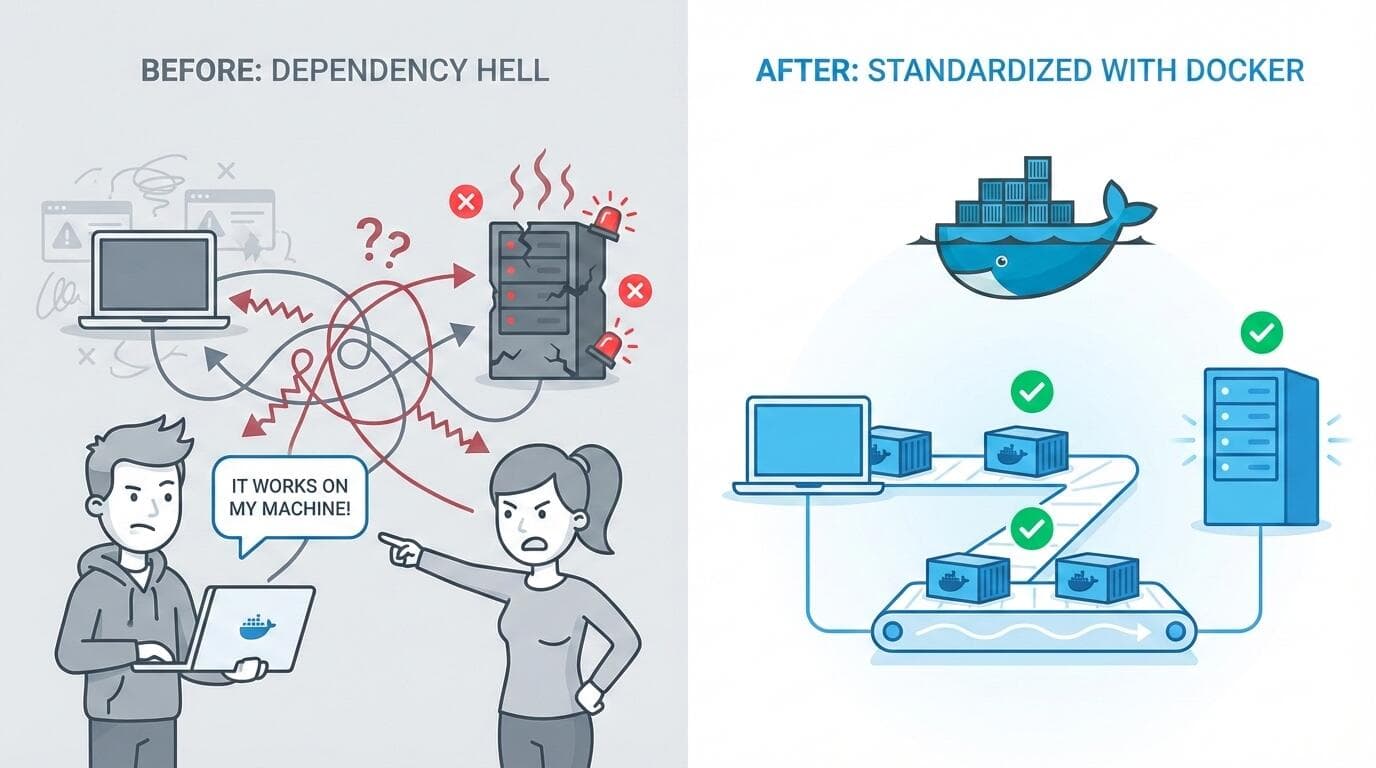
Furthermore, the complexity of modern applications, often comprised of dozens of microservices, makes manual management a logistical nightmare. Imagine trying to manage 50 Docker containers manually—ensuring they all communicate securely, have sufficient memory, and reside on the correct network. Attempting this with manual scripts or human effort is a guaranteed recipe for human error. You need an automated "brain" capable of orchestrating this complexity.
The Solution: Kubernetes as Your Fleet Commander
Kubernetes (K8s) serves as the orchestration solution acting as the "Air Traffic Controller" for your application containers. Its most revolutionary feature is Self-Healing. Kubernetes actively monitors the health of your applications every single second. If a container crashes, stalls, or becomes unresponsive, Kubernetes detects the anomaly, kills the failed unit, and spins up a fresh replacement in milliseconds. The system repairs itself before your IT team even receives an alert.
The second strategic advantage is Auto-Scaling. Unlike rigid servers, Kubernetes possesses the intelligence to detect workload spikes. If user traffic surges by 500% at 10 AM, Kubernetes automatically commands the infrastructure to provision more "troops" (Pods) to handle the load. Conversely, when traffic subsides at 10 PM, it scales down the fleet. This ensures your application remains fast and stable for customers, without your operations team frantically pushing buttons.
Finally, Kubernetes facilitates Zero-Downtime Deployment through Rolling Updates. Historically, updating an application meant displaying an "Under Maintenance" page and shutting down services for hours. With Kubernetes, updates are gradual: the system updates a small portion of the fleet first, validates stability, and then proceeds to the rest. If a bug is detected, it can automatically roll back. Your business can release new features in the middle of a business day without disconnecting a single active user.
The Business Value: Efficiency and Resilience
From an investment perspective, adopting Kubernetes translates technical resilience into Customer Trust. In a hyper-competitive market, users have zero tolerance for slow or broken applications. By guaranteeing high uptime through Self-Healing and Auto-Scaling, you safeguard your brand reputation as a reliable, professional service provider. This trust is a currency that is hard to earn but easy to lose due to poor infrastructure.
Financially, Kubernetes offers significant Cost Optimization through a mechanism known as Bin Packing. Kubernetes is incredibly intelligent at arranging applications within servers, packing them as efficiently as possible—much like a game of Tetris—so that no server resources (CPU/RAM) are wasted. Combined with dynamic scaling, you only pay for the cloud infrastructure you actually use at that moment, rather than paying for massive, idle capacity.
Lastly, Kubernetes provides Cloud Portability. As a global open-source standard, your Kubernetes configuration can run anywhere—whether on Amazon Web Services (AWS), Google Cloud (GCP), Microsoft Azure, or even your own on-premise servers. This grants your business a powerful bargaining position, preventing "vendor lock-in" and offering the long-term strategic freedom to switch providers for better pricing or performance.
The Next Step
Building an "anti-fragile" system is not an overnight task, but it is a fundamental investment for any business intending to scale. Do not let outdated infrastructure become the bottleneck to your product innovation.
The experts at Sundie Enterprise are ready to help you blueprint a Kubernetes architecture that is fit for purpose—sophisticated yet efficient. Let’s discuss how to transform your system into a resilient, autonomous fleet.