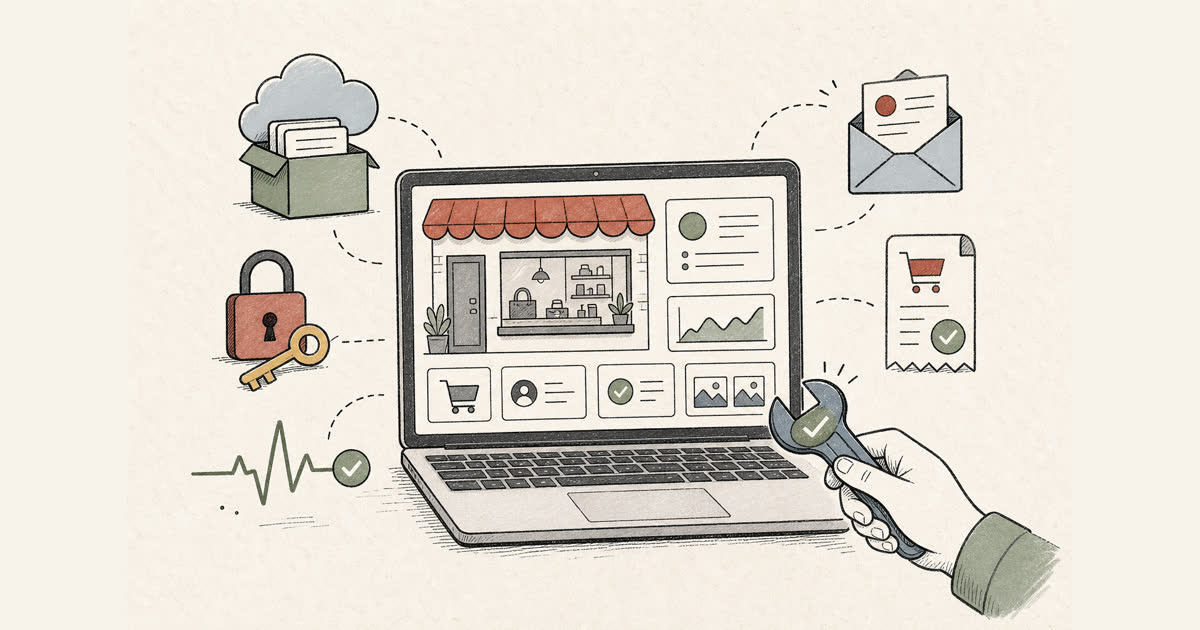

For Indonesian SMEs, a website now carries forms, payments, admin access, and customer expectations. Regular care keeps that trust believable after launch.
Website trust lives in the daily details
For many Indonesian SMEs, the first version of a website starts small, usually with a logo, a service list, an address, and a WhatsApp button. That was enough when the site only had to prove the business existed. The same site often carries more weight now. It may receive leads, take booking details, show a catalog, route payment instructions, store customer messages, and give several staff members access to the back office. Customers do not split those pieces into neat technical boxes. They see one business. If the form feels unclear, if the page loads badly during lunch hour, or if a catalog still shows an item the team stopped selling months ago, the customer has to judge whether the company is careless or merely unlucky. Most will not wait around to find out. Maintenance is the ordinary habit that keeps the website believable after launch, especially when the website has quietly become part of the front desk.
What breaks confidence before anyone calls it a problem
Trust usually leaks out through boring places. A contact form asks for a name, phone number, and maybe a document, but never says who receives it or when the customer should expect a reply. A plugin, theme, server package, or custom snippet stays untouched because everyone assumes someone else owns maintenance. A shared admin password keeps floating around after a cashier, salesperson, or freelancer has moved on. Stock, prices, booking steps, and QRIS payment notes drift away from the real operation one small edit at a time. Backups exist in theory, but nobody has tried restoring one in a safe place. None of this needs a dramatic hack or a public complaint to hurt revenue. One buyer hesitates at the form. Another abandons payment. Someone else cannot confirm availability and messages a competitor instead. The loss looks like normal silence, which is exactly why it is easy to miss.
Maintenance is business continuity in plain clothes
A website is often filed under marketing, but the work it touches is wider than that. It can connect sales, customer service, operations, and sometimes payment or order reconciliation. In Indonesia, any business that asks customers for names, phone numbers, addresses, or documents should treat data handling seriously. This article is not legal advice. The operating stance is still plain enough. Do not collect information casually if the team cannot explain where it goes, who can access it, and how it will be protected. Reliability sits beside that. When customers use an electronic system to inquire, book, pay, or follow up, downtime is no longer just an IT inconvenience. It interrupts the customer relationship. The practical answer is ownership. Someone should know what must be checked, when it was last checked, and what the team will do if the website, form, payment handoff, or admin access fails.
A care rhythm small teams can actually keep
Good maintenance should not feel like enterprise ceremony pasted onto a small shop. It should match the way inquiries and orders really arrive. Once a month, test the forms, consent wording, email routing, and CRM or spreadsheet handoff so messages do not disappear between tools. On a schedule, update the CMS, plugins, server packages, and dependencies before trouble becomes visible to customers. For access, use separate admin accounts, strong passwords, and MFA where it is available, then remove access when roles change. For backups, do one uncomfortable but useful exercise. Restore a copy somewhere safe and prove the file is more than wishful thinking. Then walk the customer path from search result to landing page, catalog, form, WhatsApp, payment, and follow-up. The point is not perfection every week. The point is to catch drift early, before it becomes a lost order, a privacy worry, or a long recovery day.
Where Sundie fits into the maintenance habit
The better question is no longer, "Do we have a website?" It is, "Can this website safely support how the business works today?" For a clinic, that may mean intake forms, appointment flow, and careful handling of patient details. For retail or F&B, it may mean catalog accuracy, QRIS readiness, order notes, and daily reconciliation. For schools, LPK, contractors, or service firms, it may mean clear inquiry handling, document requests, staff access control, and records that do not vanish when a device or account changes. Sundie fits by looking at the website as part of operations before treating visual design as the whole job. The work is to keep forms, access, content, payment handoff, backups, and continuity lined up with how the team serves customers. The operating context stays grounded in Indonesia's PDP Law reference, PP 71/2019 electronic system rules, BSSN public guidance, OWASP Top 10, CISA Stop Ransomware, NIST Cybersecurity Framework, and Bank Indonesia's QRIS page.